Mystery in the Dadès Valley (Morocco): Researchers reveal a complex life in total darkness
Scientists have discovered in Morocco unusual folded structures in ancient deep-sea sediments. These patterns, formed by chemosynthetic microbial mats 180 million years ago, reveal a complex ecosystem that thrived in total darkness.
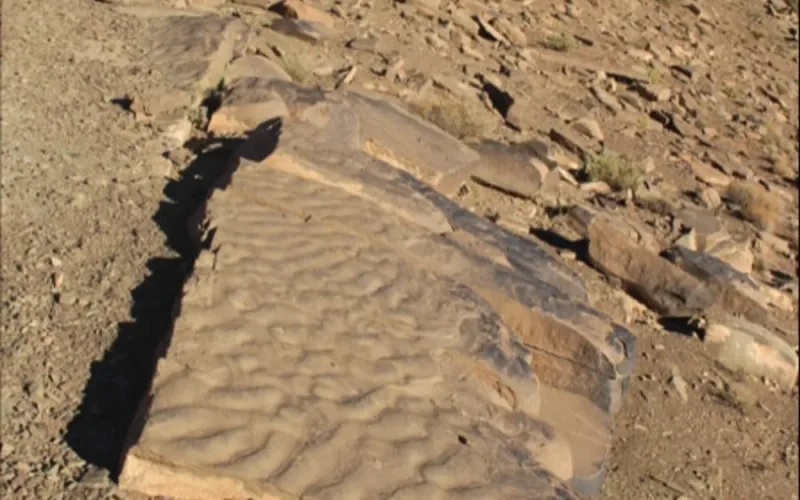
Paleoecologist Rowan Martindale and her team identified these "folded structures" during an expedition in the Dadès Valley, in the heart of the High Atlas Mountains. These small millimeter-scale ridges, usually observed in shallow, sunlit waters, were found here within turbidites, sediments deposited at depths greater than 180 meters.
This discovery, reported by the Geological Society of America, challenges geological certainties. Dating back 180 million years, these rocks come from a time when animal diversification was intensely disturbing the seafloor. Normally, the activity of burrowing organisms would have erased these delicate microbial textures before fossilization.
Chemical analyses revealed high levels of carbon under the folds, confirming a biological origin. Unlike the surface-dependent, photosynthesis-driven folded structures, those of the Dadès were formed by chemosynthetic bacteria. These microorganisms derive their energy from chemical reactions, not from sunlight. Chemosynthetic ecosystems and Jurassic folded structures in Morocco
The formation process is closely linked to the dynamics of submarine currents. Turbidity flows transported nutrients to the depths while lowering oxygen levels in the sediments. These specific conditions favored the development of bacterial mats during the calm periods between two debris deposits.
The study suggests that these microbial mats spread across the seafloor, creating the undulations observed by the researchers. While most of these structures were destroyed by successive flows, some were exceptionally buried and preserved, providing rare evidence of life in the darkness of ancient oceans.
This advance now encourages geologists to reconsider the interpretation of global rock archives. By demonstrating that these patterns are not exclusively the result of photosynthesis, Dr. Martindale’s team opens new avenues to detect traces of ancient life in deep-sea environments that have been neglected so far.