Moroccans expelled from the United States to countries that were not theirs
The Trump administration set aside at least 410 million dollars to persuade third countries to accept those it expelled. Among the people sent to countries where they had no ties were several Moroccan nationals.
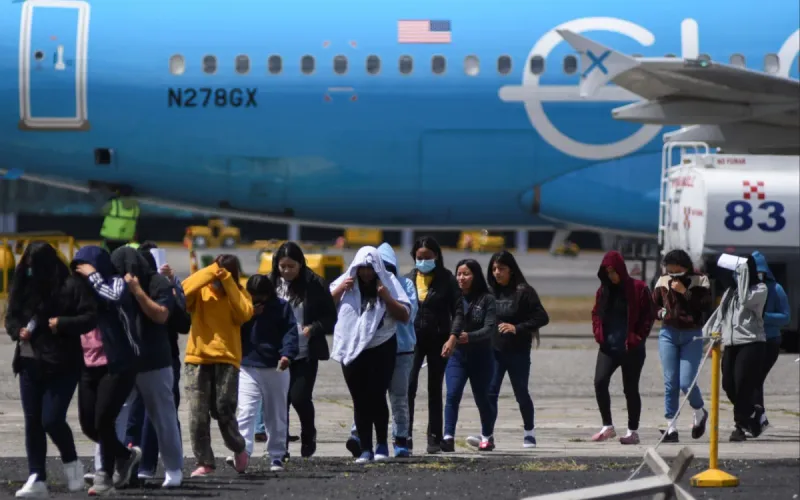
Since Donald Trump returned to the White House, at least 25,447 foreigners have been expelled from the United States to countries of which they are not nationals. The arrangement also concerns Moroccans, who were sent notably to Cameroon and Costa Rica.
These figures come from the “Deportation Project,” an investigation coordinated by Forbidden Stories with 72 journalists from 23 media outlets. Published this Monday, September 21, it documents a system operating largely out of public view, whose main findings are compiled by PBS Frontline.
The U.S. administration has reached agreements with at least 35 countries. Twenty-eight of them have already received people who were expelled and who sometimes had no family, legal or personal connection with their new country of destination.
On Bladi.net : article 119537
To secure this cooperation, Washington had planned to mobilize at least 410 million dollars. The documents reviewed by the journalists show 81 million intended directly for the signatory governments, more than 178 million for the International Organization for Migration and more than 123 million for the United Nations High Commissioner for Refugees.
Moroccans sent to Cameroon and Costa Rica
Moroccan nationals appear in several of the operations documented. On January 15, nine people from Morocco, Angola, Ghana, the Democratic Republic of the Congo and Zimbabwe had been transported to Cameroon. Most of them nevertheless benefited in the United States from protection against being returned to their countries of origin.
Among them was Farah, a Moroccan woman who had obtained protection from a U.S. judge because of the risks she said she faced in Morocco. She had nevertheless been placed on a plane to Cameroon, where she knew no one, before eventually being returned to Morocco. Bladi had then recounted the journey of this young Moroccan woman expelled despite the protection granted by U.S. justice.
Other Moroccans were sent to Costa Rica. A first group of 25 migrants of different nationalities arrived there on April 11. In exchange for accepting these people, the United States was to finance their care, while the International Organization for Migration was responsible in particular for accommodation and food during the first few days.
On Bladi.net : article 120650
The investigation reveals that these transfers do not constitute a succession of isolated operations. They are notably managed by a new “Office of Remigration,” established within the State Department and tasked with negotiating the agreements as well as the funding provided to partner countries.
The use of third countries allows Washington to expel foreigners when their direct return to their country of origin is impossible or prohibited by a judge. In some cases, the intermediary country subsequently repatriates them to the territory they had fled.
A U.S. federal appeals court also rejected on September 18 the procedure allowing these expedited expulsions without a sufficient opportunity to challenge them. But the Trump administration is expected to continue the legal battle over a system that has become central to its immigration policy.
The investigation thus provides a precise measure of its scale: more than 25,000 people displaced, 35 international agreements and at least 410 million dollars earmarked to persuade foreign governments to accept migrants, including Moroccans, with whom they often had no connection.